
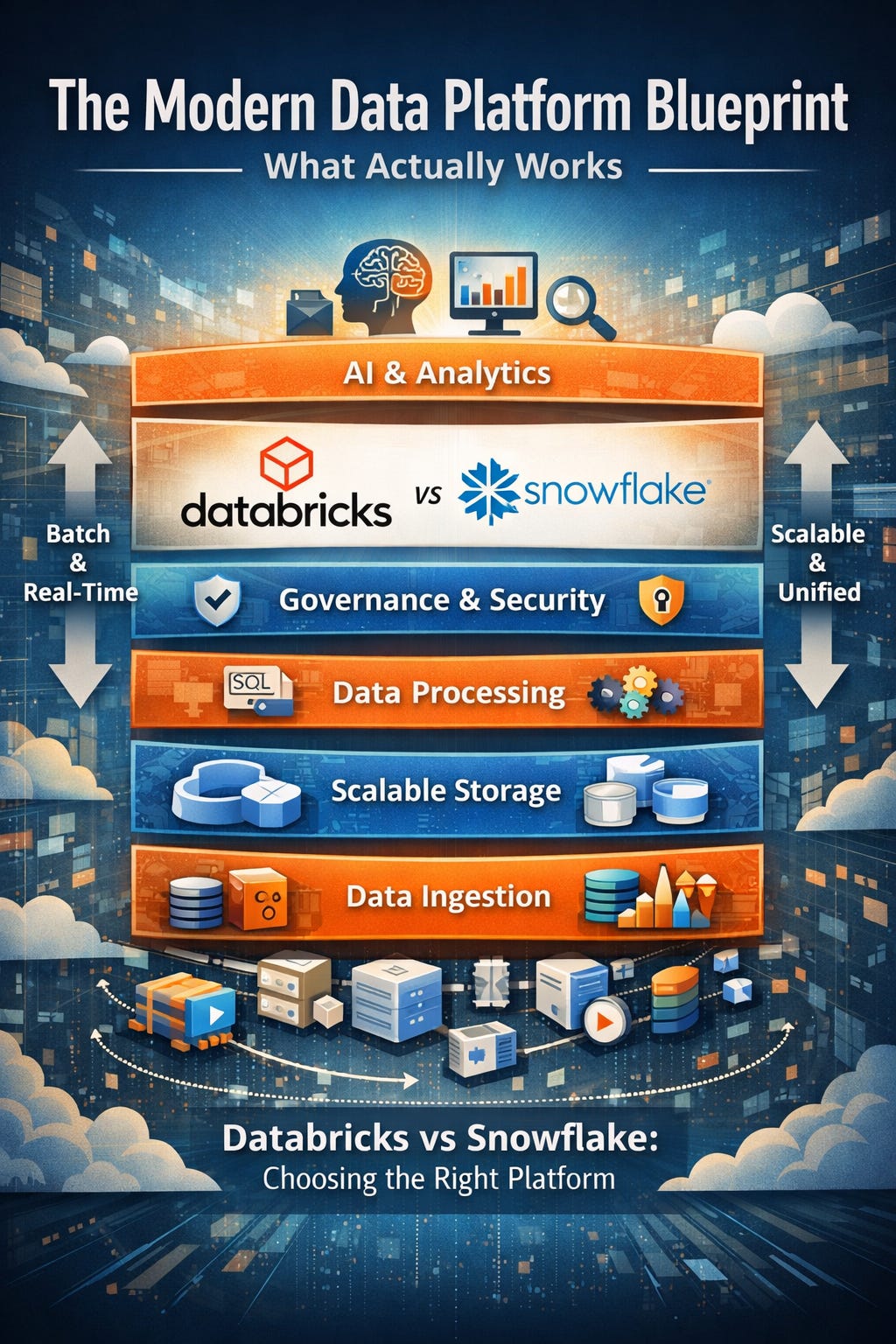
The Modern Data Platform Blueprint: What Actually Works (Databricks vs Snowflake Reality)

Every organization says they’re building a “modern data platform.”
Very few are.
After leading platform architecture across AWS, Azure, GCP—and implementing both Databricks and Snowflake in enterprise environments—I’ve seen what works, what fails, and what gets misunderstood.
Here’s the reality:
The platform you choose matters far less than how you design it.
The Industry Is Debating the Wrong Thing
Most conversations today sound like this:
“Should we use Databricks or Snowflake?”
“Should we build a lakehouse or a warehouse?”
“Do we need streaming or batch?”
These are valid questions.
But they’re not the right starting point.
Because none of them matter if your architecture can’t:
Deliver trusted data
Support production workloads
Scale across teams and domains
Enable AI—not just reporting
The real question is:
Can your platform consistently deliver decision-ready data at scale?
What a Modern Data Platform Actually Needs to Do
At scale, your platform must support five core capabilities:
1. Data Ingestion (Batch + Real-Time)
APIs, CDC, event streams
Kafka, Pub/Sub, streaming pipelines
Reliable, repeatable ingestion patterns
If ingestion is inconsistent, everything downstream breaks.
2. Scalable Storage (Lakehouse Foundation)
Object storage (S3, ADLS, GCS)
Structured + unstructured data
Support for raw → curated → enriched layers
This is where most organizations underinvest early—and pay for it later.
3. Processing & Transformation
Spark, SQL engines, distributed compute
ELT/ETL pipelines
Medallion architecture (Bronze → Silver → Gold)
This layer turns data into something usable.
4. Governance & Trust Layer
Catalog, lineage, access control
Data quality rules
Security and compliance
This is the most ignored—and most critical—layer.
Without governance:
Your data platform becomes a liability, not an asset.
5. Consumption & AI Enablement
BI tools (Power BI, Tableau, Looker)
APIs and applications
ML models and GenAI systems
This is where value is realized.
Everything else is just infrastructure.
The Architecture Pattern That Works
The most effective platforms I’ve built follow a simple principle:
Separate concerns, but unify access.
That means:
Modular layers (ingestion, storage, processing, governance, consumption)
Shared data standards
Centralized governance with domain-level ownership
Interoperability across tools
This is what enables scale—not any single technology.
Where Most Platforms Fail
Across enterprises, I consistently see the same breakdowns:
❌ Over-Engineering Too Early
Teams design for scale before proving value.
❌ Governance as an Afterthought
Data becomes unusable because no one trusts it.
❌ Tool Sprawl
Too many platforms, no unified architecture.
❌ No Clear Ownership
No accountability for data quality or lifecycle.
❌ Cost Explosion
No FinOps discipline, leading to runaway cloud spend.
Databricks vs Snowflake: The Reality
Let’s simplify the debate.
Both are enterprise-grade platforms.
Both can succeed—or fail—depending on how they’re implemented.
Where Databricks Excels
Advanced AI/ML and GenAI workloads
Real-time and streaming pipelines
Open ecosystem (Delta Lake, MLflow, notebooks)
Flexibility for engineering-heavy teams
Best for:
Organizations prioritizing AI, ML, and real-time data processing
Where Snowflake Excels
Simplicity and ease of adoption
Strong SQL performance and analytics
Built-in governance and data sharing
Lower barrier for business users
Best for:
Organizations focused on analytics, reporting, and data sharing
The Wrong Way to Decide
Most organizations choose based on:
Vendor relationships
Market hype
Short-term convenience
This leads to long-term architectural problems.
The Right Way to Decide
Instead, evaluate based on:
Primary workloads (AI vs analytics vs hybrid)
Real-time vs batch requirements
Governance maturity
Team skillsets
Long-term scalability
The platform should align to your operating model—not the other way around.
The Foundation of Every Successful AI System
Every high-performing AI system I’ve built or seen has one thing in common:
A strong, well-governed data platform underneath it.
Without that:
Models fail in production
Outputs are inconsistent
Trust breaks down
Adoption stalls
With it:
AI scales
Insights become actionable
Decision-making improves
Business value compounds
Final Thought
The modern data platform is not a product you buy.
It’s an architecture you design.
And the organizations that understand this will have a decisive advantage in the AI era.
In the next article, I’ll break down one of the most misunderstood topics in enterprise AI:
RAG vs Fine-Tuning — what actually works in production, and why most implementations get it wrong.
Tags - Data Platforms, Data Architecture, Cloud Architecture, Data Engineering, Enterprise AI, AI Architecture, Digital Transformation, Technology Strategy, CIO, CTO, Chief Data Officer, Executive Leadership, Business Strategy, Technology Strategy, Innovation
Hashtags - #DataPlatforms #DataArchitecture #CloudArchitecture #DataEngineering #EnterpriseAI #AIArchitecture #DigitalTransformation #TechnologyStrategy #CIO #CTO #ChiefDataOfficer #ExecutiveLeadership